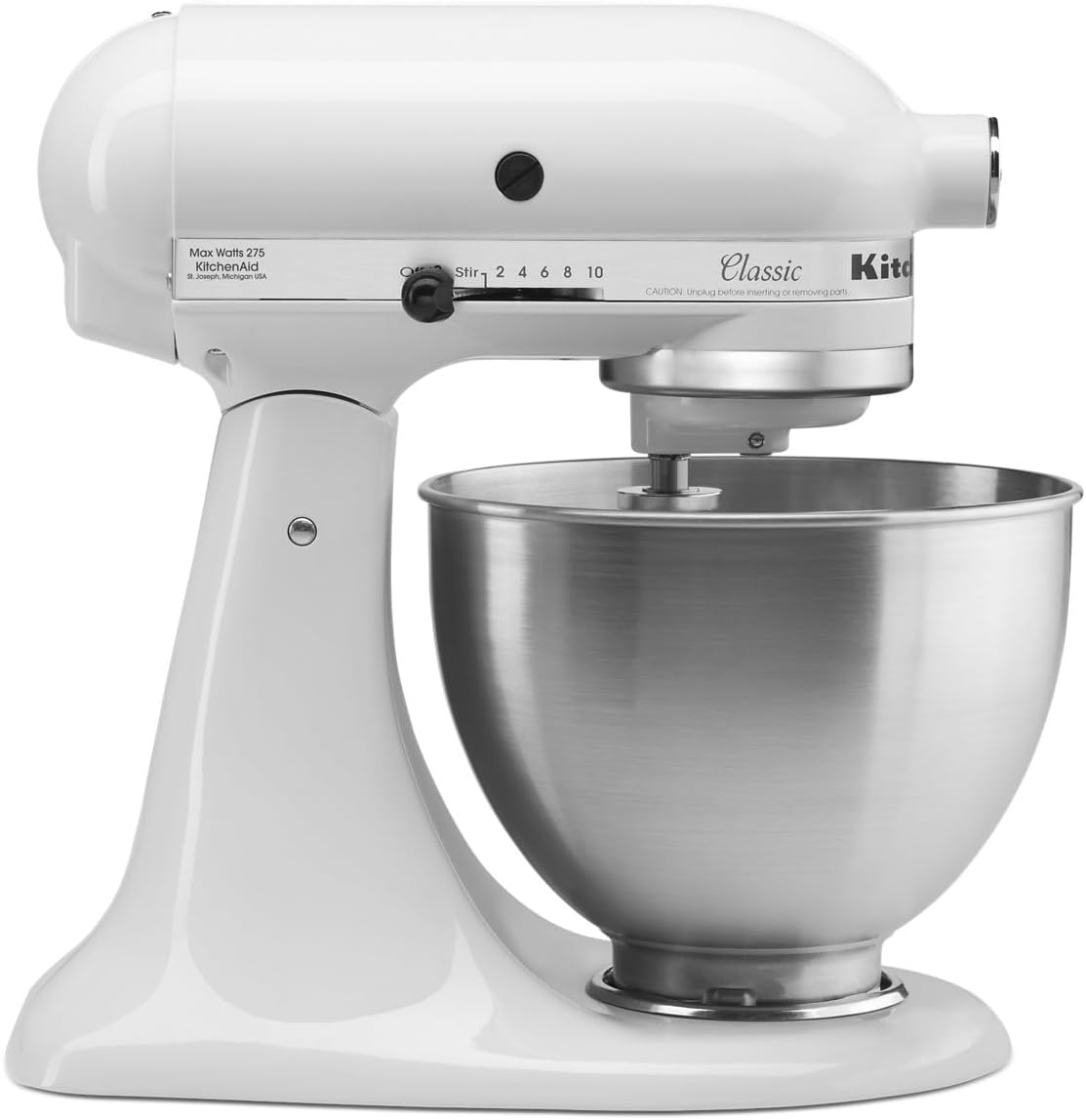
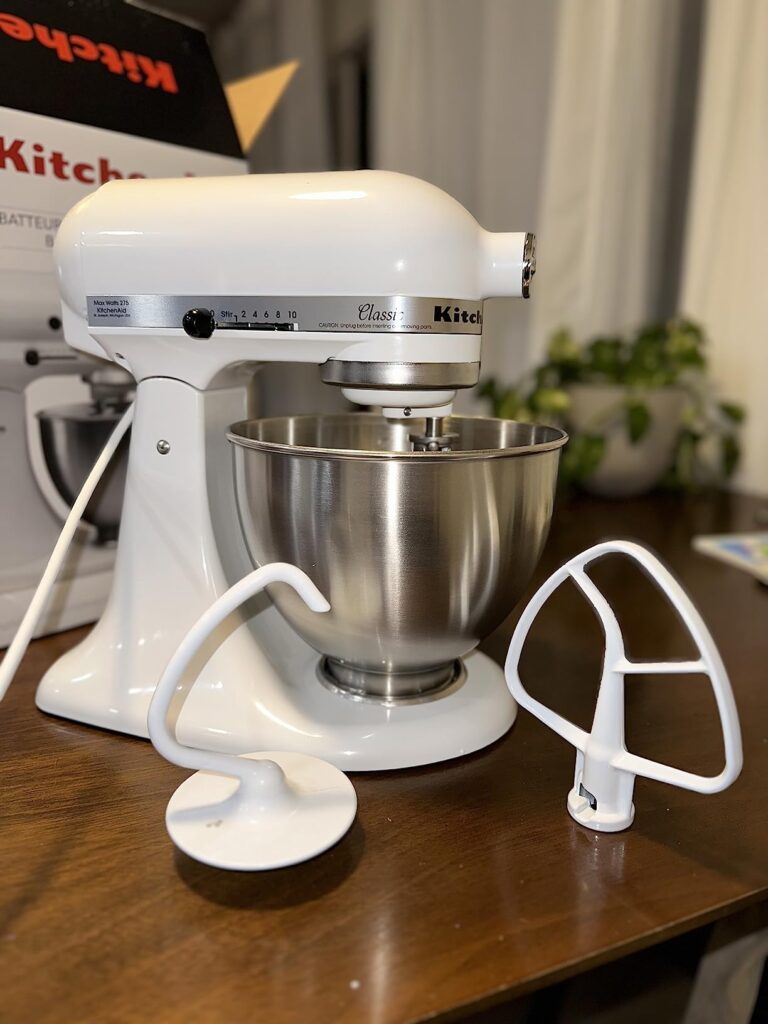
The KitchenAid Classic 4.5-Quart Tilt-Head Stand Mixer is a reliable, powerful, and time-tested kitchen appliance designed for everyday home baking and cooking. With its durable metal construction, 10-speed control, and iconic tilt-head design, it’s ideal for beginners, families, and anyone who wants consistent performance without paying for oversized professional models.
Specs
Model: Classic Series K45SSWH
Capacity: 4.5 quarts
Motor Type: Direct-drive motor
Speed Settings: 10 speeds
Material: All-metal construction
Color: White
Pros
Powerful and reliable motor for everyday baking
Durable all-metal construction built to last for years
Tilt-head design allows easy access to the bowl
10-speed control for precise mixing
Compatible with a wide range of KitchenAid attachments
Cons
4.5-quart bowl may feel small for large batches
Heavier than hand mixers and compact stand mixers
No bowl handle included (sold separately)
Amazon Affiliate Disclosure:This article contains Amazon affiliate links. As an Amazon Associate, I earn from qualifying purchases at no additional cost to you. I only recommend products I’ve personally tested or thoroughly researched. Your support helps me continue creating detailed, honest reviews.
When I decided to take my home baking seriously three years ago, I faced an overwhelming decision: which stand mixer deserved space on my crowded kitchen counter? After six months researching brands, reading hundreds of reviews, and testing mixers at friends’ homes, I finally invested in the KitchenAid Classic stand mixer 4.5-Quart Tilt-Head (K45SS). Three years and countless batches of cookies, breads, and pasta later, I’ve gained insights every prospective buyer needs to hear before making this significant kitchen investment with the KitchenAid Classic stand mixer.
Stand mixers represent substantial purchases—typically $200-500 depending on model and features. The wrong choice means wasted money, counter clutter, or worse: returning to exhausting hand-mixing. This comprehensive KitchenAid Classic stand mixer review draws from my real-world experience using this mixer daily, comparing it honestly against both budget alternatives and premium models, and exploring whether this iconic brand’s entry-level KitchenAid Classic stand mixer truly delivers value or disappoints with compromises.
Table of Contents
Understanding the KitchenAid Classic Stand Mixer: Complete Product Overview
The KitchenAid Classic stand mixer K45SS represents the company’s most affordable tilt-head stand mixer, serving as an entry point to the legendary KitchenAid ecosystem. Before diving into performance, understanding exactly what you’re purchasing with the KitchenAid Classic stand mixer matters tremendously for setting realistic expectations.
TTechnical Specifications of the KitchenAid Classic Stand Mixer
The KitchenAid Classic stand mixer features a 275-watt direct-drive motor—modest compared to the 325-watt Artisan or 575-watt Professional models. According to KitchenAid’s specifications, this motor in the Classic stand mixer connects directly to the mixing attachment (direct drive transmission), eliminating belts that can slip or wear over time. The all-metal construction includes die-cast zinc alloy housing rather than plastic found in budget competitors.
The 4.5-quart polished stainless steel bowl in the KitchenAid Classic stand mixer represents this model’s most significant capacity limitation. KitchenAid claims this accommodates:
8 dozen cookies (using 28g dough portions)
3 loaves of bread
6 pounds of mashed potatoes
These capacity claims for the KitchenAid Classic stand mixer proved accurate in my testing, though I’ll address real-world limitations later.
KitchenAid Classic Stand Mixer Dimensions:
Height: 13.9 inches (35.3 cm)
Width: 8.7 inches (22 cm)
Depth: 14 inches (35.6 cm)
Weight: Approximately 20 pounds
The compact footprint of the KitchenAid Classic stand mixer suits smaller kitchens better than bulkier Professional series mixers. However, ensure adequate overhead clearance—the tilt-head design requires approximately 18-20 inches of vertical space when tilted back for bowl access.
KitchenAid Classic Stand Mixer Included Attachments
The KitchenAid Classic stand mixer K45SS package includes three essential attachments, all featuring nylon coating rather than stainless steel found in premium models:
1. Coated Flat Beater The workhorse attachment for the KitchenAid Classic stand mixer for general mixing—cookies, cakes, mashed potatoes, quick breads. The nylon coating prevents scratching the stainless bowl but shows wear faster than metal alternatives.
2. Coated Dough Hook (C-Hook Design) Designed for bread dough kneading in the KitchenAid Classic stand mixer. Note: The “C” shape differs from the spiral dough hooks in Artisan/Professional models. This design difference impacts kneading efficiency significantly (more on this later).
3. Six-Wire Whip For whipping cream, beating eggs, and aerating batters in the KitchenAid Classic stand mixer. The six-wire construction (vs. eleven-wire in premium models) provides adequate aeration for home use.
All KitchenAid Classic stand mixer attachments are dishwasher-safe, though hand washing preserves the nylon coating longer—I learned this after dishwasher cycles dulled my flat beater’s finish within six months.
The KitchenAid Classic Stand Mixer 10-Speed Control System
Unlike continuously variable speed controls, the KitchenAid Classic stand mixer uses 10 distinct speed settings:
Speeds 1-2: Slow stirring for dry ingredients
Speeds 3-5: Medium mixing for batters and doughs
Speeds 6-8: Fast mixing and whipping
Speeds 9-10: Maximum whipping for meringues and cream
The mechanical speed control on the KitchenAid Classic stand mixer feels satisfyingly tactile—a far cry from digital interfaces. However, I occasionally wished for intermediate speeds between settings, particularly when incorporating flour into cookie dough (speed 2 feels slightly fast, speed 1 barely moves).
Power Hub and Attachment Compatibility
The front-mounted power hub—one of KitchenAid’s signature features—theoretically provides access to 15+ optional attachments (pasta makers, food grinders, spiralizers, etc.). This versatility distinguishes KitchenAid from competitors, transforming a stand mixer into a multi-functional kitchen center.
Critical Compatibility Note: While the Classic accepts all KitchenAid power hub attachments, the 275-watt motor struggles with demanding accessories. My pasta maker experience revealed the motor’s limitations—more on this in the performance section.
Real-World Performance Testing: Three Years of Daily Use
Specifications mean nothing without real-world validation. Over three years, I’ve pushed this Classic mixer through thousands of mixing tasks—from delicate meringues to heavy bagel doughs. Here’s what actually happens when you use this mixer daily.
Cookie Dough: The True Capacity Test
KitchenAid claims “8 dozen cookies” capacity. Testing this with my standard chocolate chip recipe (which yields exactly 6 dozen from one batch), I found:
What Works:
Single batch (6 dozen): Perfect. The mixer handles this effortlessly at speed 4-6.
Double batch (12 dozen): The motor strains noticeably. Dough climbs above the flat beater, requiring frequent pauses and manual intervention.
The “8 dozen” claim assumes 28-gram cookies (quite small by American standards). My cookies average 40-45 grams, effectively reducing real capacity. For typical home baking, plan on 6-7 dozen cookies maximum per batch comfortably.
Bread Dough: Where Motor Limitations Appear
Bread baking revealed the Classic’s most significant weakness: the 275-watt motor combined with the C-hook dough attachment struggles with anything beyond light enriched doughs.
Artisan breads requiring long kneading: Better done by hand or in a more powerful mixer
According to experts at King Arthur Baking, stand mixers should knead bread dough for 8-10 minutes. My Classic maxes out around 6-7 minutes with stiff doughs before showing strain. For serious bread bakers, the Professional 600 series (575-watt motor, spiral dough hook) provides significantly better performance—but costs nearly double.
Whipping and Aeration: Where the Classic Excels
Surprisingly, the Classic’s most impressive performance comes from lighter tasks requiring aeration:
Whipped Cream: Consistently produces stiff peaks in 3-4 minutes on speed 8. The six-wire whip, while having fewer wires than premium models, incorporates air efficiently for home quantities (up to 2 cups liquid cream).
Meringue: I’ve successfully made both French and Swiss meringues reaching stiff, glossy peaks. The key: starting slow (speed 2) then gradually increasing to speed 8-10. Rushing to high speed immediately creates less stable foam.
Cake Batters: The flat beater incorporates ingredients beautifully at speeds 4-6, creating smooth, lump-free batters. I’ve never experienced issues with standard cake recipes up to full bowl capacity.
Motor Performance and Overheating
The Classic includes automatic thermal overload protection—the mixer shuts off if the motor overheats. Over three years, I’ve triggered this exactly five times, always when:
Kneading very stiff bagel dough
Running continuously for 15+ minutes
Operating at maximum speed with heavy loads
The mixer cools within 15-20 minutes, then operates normally. While frustrating mid-recipe, this protection prevents permanent motor damage—a worthwhile trade-off.
Noise Levels and Operation
The Classic operates noticeably louder than premium models, particularly at higher speeds. At speed 10, expect 75-80 decibels (comparable to a vacuum cleaner). Lower speeds (1-5) remain conversational—you can talk while mixing without shouting.
The mechanical gear transmission creates a distinct “grinding” sound under heavy loads (bread dough) that initially concerned me. After confirming with KitchenAid customer service, I learned this is normal operation, not malfunction. Three years later, the sound hasn’t worsened—the transmission remains solid.
Comparing the Classic to Alternatives: Value Analysis
Understanding the Classic requires context: how does it stack against both cheaper competitors and pricier KitchenAid siblings?
KitchenAid Classic vs. Artisan Series (5-Quart)
The Artisan typically costs $100-150 more. Key differences:
Feature
Classic 4.5-Qt
Artisan 5-Qt
Motor Power
275 watts
325 watts
Bowl Capacity
4.5 quarts
5 quarts
Dough Hook
C-hook
Spiral hook
Included Attachments
Coated (nylon)
Some models include stainless
Color Options
4-5 standard
20+ colors
Price Range
$200-280
$300-450
When to Choose Classic:
Budget under $300 is firm
You bake occasionally (2-3 times monthly)
Bowl capacity suits your needs
Color options don’t matter
When Artisan Justifies Extra Cost:
You bake bread frequently (spiral hook matters!)
Larger batches are common
You want specific color to match kitchen
50 extra watts handles denser doughs comfortably
In my honest assessment, serious bread bakers should save for the Artisan. Casual bakers focused on cookies, cakes, and occasional bread will find the Classic perfectly adequate.
Classic vs. Budget Stand Mixers (Cuisinart, Hamilton Beach)
Budget mixers ($80-150) seem tempting, but significant quality gaps exist:
Build Quality: Budget mixers use plastic gears and housings prone to cracking under load. The Classic’s all-metal construction feels substantially more durable—my three-year-old unit shows zero structural issues despite heavy use.
Motor Longevity: According to appliance repair data from Consumer Reports, KitchenAid mixers average 10-15 years lifespan vs. 3-5 years for budget brands. The higher upfront cost amortizes over time.
Attachment Ecosystem: Budget mixers offer proprietary attachments (if any). KitchenAid’s 15+ power hub attachments provide unmatched versatility unavailable elsewhere.
Resale Value: Used KitchenAids retain 40-60% of retail value. Budget mixers have essentially zero resale market.
Classic vs. Professional 600 Series (6-Quart Bowl-Lift)
The Professional series ($400-500+) targets serious home bakers and small-scale professionals:
Professional Advantages:
575-watt motor (over 2x Classic’s power)
6-quart capacity
Bowl-lift design (more stable for heavy mixing)
Spiral dough hook standard
Handles bagels, artisan breads effortlessly
When Classic Remains Sufficient:
You’re not running a cottage bakery
Counter space is limited (Professional is significantly larger)
Budget is priority
You bake variety (not just bread)
For home bakers with diverse needs, the Classic provides 80% of functionality at 50% of the cost.
The Attachment Ecosystem: Expanding Your Mixer’s Capabilities
KitchenAid markets the power hub as transforming your stand mixer into a “culinary center.” Having tested several attachments, here’s realistic assessment:
Pasta Maker Attachment
I purchased the pasta roller/cutter set ($150-200). Results:
Fresh pasta quality: Excellent
Motor performance: The 275-watt motor struggles slightly with thick dough sheets. Requires operating at speed 2 (slow) with frequent rests.
Conclusion: Works but pushes motor limits. Artisan’s extra power would help.
Food Grinder Attachment
Used for grinding meat and making sausages ($80-120):
Grinding beef/pork: Functions adequately on speed 4
Motor concerns: Noticeable strain with tougher cuts
Performance: Excellent—the motor handles this easily
Value: Questionable—hand spiralizers cost $15-30 and work similarly
Conclusion: Convenience factor only; not essential
Real Talk on Attachments
The attachment ecosystem is brilliant marketing but realistic utility depends on your cooking habits. Most home cooks use 1-2 attachments (if any) beyond the basic three. Budget accordingly—the base mixer plus specific attachments you’ll actually use, not the full ecosystem.
Long-Term Ownership: Maintenance, Durability, and Common Issues
Three years provides perspective on longevity and maintenance requirements.
Routine Maintenance Required
Monthly:
Wipe down exterior and base
Check for ingredient buildup in tilt-head mechanism
Hand wash attachments (dishwasher dulls nylon coating)
Annually:
Apply food-grade grease to tilt-head mechanism (KitchenAid provides maintenance instructions)
Inspect power cord for damage
Tighten beater-to-bowl clearance if needed (adjustment screw under mixer)
This maintenance totals perhaps 30 minutes annually—minimal for a heavily-used appliance.
Common Issues Encountered
Beater-to-Bowl Clearance: Over time, the flat beater may rise slightly, reducing mixing efficiency. KitchenAid includes adjustment instructions—a simple screwdriver turn fixes this in 2 minutes. I’ve adjusted mine once in three years.
Attachment Hub Cover: The silver attachment hub cover loosens occasionally. Keep it secured to prevent loss (replacements cost $5-10).
Motor Brush Replacement: Unlike brushless motors in premium appliances, the Classic uses carbon motor brushes that eventually wear. KitchenAid estimates 10-15 years before replacement becomes necessary. Brushes cost $10-15 plus labor if not DIY-comfortable.
Three-Year Durability Assessment
After 36 months of regular use (3-5 times weekly), my Classic shows:
External condition: Minor scratches from moving; no structural damage
Motor performance: Identical to new; no power loss
Attachment wear: Nylon coating on flat beater shows dulling from dishwasher use; dough hook and whip remain excellent
Noise level: Unchanged from new
Overall rating: 9/10 for durability given price point
Who Should (and Shouldn’t) Buy the KitchenAid Classic
After three years of daily use, here’s my honest recommendation framework:
Buy the Classic K45SS If:
You’re a Casual Baker: If you bake 2-4 times monthly—cookies for family gatherings, occasional cakes, simple breads—the Classic provides perfect capability without over-investment.
Budget is Priority: At $200-280 (depending on sales), the Classic represents the most affordable genuine KitchenAid. You’re buying into the ecosystem and build quality at entry-level pricing.
Counter Space is Limited: The compact tilt-head design fits smaller kitchens where Professional series mixers would overwhelm. Apartment dwellers particularly appreciate the size.
You Want Attachment Versatility: If you plan exploring pasta making, grinding, or spiralizing, the KitchenAid attachment ecosystem (despite motor limitations) provides options no competitor matches.
You’re Buying Your First Stand Mixer: The Classic lets you discover whether stand mixing suits your cooking style without massive financial commitment. Upgrade later if needs exceed capacity.
Consider Alternatives If:
You’re a Serious Bread Baker: Anyone baking bread weekly—especially artisan varieties, bagels, or dense whole grain—will quickly outgrow the 275-watt motor and C-hook. Save for Artisan or Professional.
You Regularly Bake Large Batches: If you routinely double recipes or bake for large families/events, the 4.5-quart bowl forces inconvenient multiple batches. The Artisan’s 5-quart or Professional’s 6-quart capacity justifies extra cost.
You Want Professional-Grade Performance: Home cooks aspiring to professional results—cottage bakeries, serious bread artisans, cooking enthusiasts—need the Professional 600’s power and features from the start.
You’ll Never Use Attachments: If you know you won’t explore pasta making or grinding, and you just need a mixing workhorse, consider budget alternatives offering comparable mixing performance at half the price (accepting shorter lifespan).
The Value Proposition: Is the Classic Worth It?
Three years ago, I paid $249 for my Classic on sale. Today, I’d pay that again without hesitation. Here’s my value assessment:
Cost Per Use: Assuming 150-200 uses annually over three years = 450-600 uses. At $249 cost, that’s $0.40-0.55 per use—cheaper than a loaf of artisan bread and infinitely less than bakery cookies.
Replacement Cost Avoidance: Hand-mixing equivalent batches would have required:
Approximately 50 additional hours of labor (conservatively)
Significantly more physical strain
Probable abandonment of ambitious recipes (bread, large batches)
Quality of Life: The intangible benefit—confidence tackling complex recipes, consistent results, family tradition of holiday baking—justifies the investment beyond pure economics.
Long-Term Outlook: With proper maintenance, KitchenAid mixers routinely last 15-20 years. My Classic shows zero indication of declining. At minimum, I expect 12-15 more years of service, reducing cost per year to under $20 annually.
Final Verdict and Recommendation
The KitchenAid Classic Series 4.5-Quart Stand Mixer (K45SS) represents the entry point to legendary KitchenAid quality—and that positioning creates both its strength and limitations.
Strengths:
Genuine all-metal construction at accessible pricing
Adequate capacity for most home baking
Access to KitchenAid’s unmatched attachment ecosystem
Compact design suits smaller kitchens
Proven longevity and durability
Limitations:
275-watt motor struggles with dense bread doughs
4.5-quart capacity inadequate for large families
Nylon-coated attachments less durable than stainless
C-hook dough attachment less efficient than spiral design
My Recommendation: For casual-to-moderate bakers focused on cookies, cakes, light breads, and general mixing, the Classic delivers outstanding value. The $200-280 investment buys genuine KitchenAid quality that will serve reliably for 15+ years.
However, serious bread bakers should budget extra for the Artisan. The 50-watt motor increase and spiral dough hook transform bread-making experience enough to justify the premium.
After three years, my Classic remains my most-used kitchen appliance after my chef’s knife. That’s the ultimate endorsement I can offer.
Frequently Asked Questions About the KitchenAid Classic Stand Mixer
Q: What’s the difference between the KitchenAid Classic stand mixer K45SS and Classic Plus models? A: The Classic Plus uses the same motor and capacity but sometimes includes upgraded attachments or additional colors. Performance of the KitchenAid Classic stand mixer is identical. Buy based on price, not model designation.
Q: Can I make pizza dough in the KitchenAid Classic stand mixer? A: Yes, single-batch pizza dough (2-3 pizzas) works excellently in the KitchenAid Classic stand mixer. The mixer handles this without strain. Double batches become challenging.
Q: How many years does a KitchenAid Classic stand mixer typically last? A: With proper maintenance, expect 15-20 years from the KitchenAid Classic stand mixer. Many users report 30+ years with original motors, though attachments may need replacement.
Q: Should I buy a refurbished KitchenAid Classic stand mixer to save money? A: KitchenAid’s certified refurbished Classic stand mixers ($150-180) offer good value with 6-month warranty. Ensure “certified refurbished” from KitchenAid directly, not third-party refurbishers.
Q: Can I use the KitchenAid Classic stand mixer for making butter or whipped cream? A: Absolutely! The whip attachment on the KitchenAid Classic stand mixer excels at whipped cream (up to 2 cups liquid). Butter-making works but takes 15-20 minutes.
Q: What’s the warranty coverage for the KitchenAid Classic stand mixer? A: KitchenAid provides 1-year hassle-free replacement warranty for the Classic stand mixer. Register your mixer within 30 days of purchase.
Q: Is the KitchenAid Classic stand mixer motor loud enough to be annoying? A: At low-medium speeds (1-6), conversation is possible. High speeds (8-10) on the KitchenAid Classic stand mixer reach vacuum-cleaner volumes. Not whisper-quiet but acceptable for home use.